
Tire Maintenance Manual
- Inspection & Repairs
- Read Tire Sidewall
- Driving Tips
Even if you don't put a ton of miles on your vehicle, you should inspect your tires at least once a month and always before long trips. It's important to keep an eye out for excessive or irregular tread wear, underinflation, or damage like scrapes, bulges, cracks, punctures and more. If any of these conditions are present, or if you are experiencing continuous pressure loss, the tire should be dismounted and inspected for damage by a trained tire professional to determine if a repair can be made.
Tire Wear & Tear
To help maintain even treadwear and prolong tire life, review this quick reference about alignment, rotation, and visual inspections.
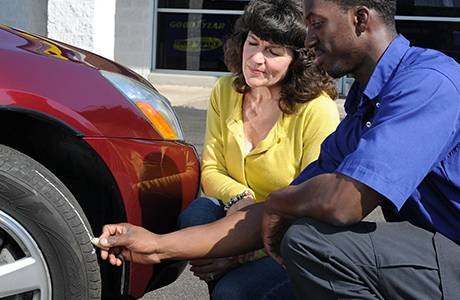
Misalignment of the front or rear wheels can cause rapid or uneven wear. Front-wheel-drive vehicles and those with independent rear suspension require alignment of all four wheels, instead of two. Getting your alignment checked as specified in your vehicle's owner's manual is the recommended way to prolong tire life.
Sometimes irregular tire wear can be corrected by rotating your tires. Consult your vehicle's owner's manual. If your tires show uneven wear, ask a Dunlop expert to check for and correct any misalignment, imbalance, or other mechanical problem involved before rotation.
A tire's tread directly affects how it grips the road, so it's important to regularly inspect it visually for signs of uneven wear. These signs can include high or low areas, or unusually smooth ones.
Visual Inspection
Inspecting your tires can help you find punctures or other visible signs of damage that could necessitate replacement.
Repairs
It's crucial to know when it's okay to have a tire repaired and when a tire should be replaced.
- If a tire loses air pressure, it should be removed for an internal inspection.
- Driving on a flat tire for even a short distance can ruin it.
- Most punctures, nail holes, or cuts up to 1/4 in. (.64 cm) can be repaired if the damage is confined to the tread.
- Do not repair any sidewall or tread punctures larger than 1/4 in. (.64 cm), and NEVER repair tires worn below 1/16 in. (.16 cm).
Wheel Balance and Alignment
Having your tires balanced and your vehicle properly aligned is important for tire longevity and vehicle performance.
- Unbalanced tires cause road vibration, which can lead to driver fatigue, premature tire wear (also known as cupping or dipping), and unnecessary wear to your vehicle's suspension.
- Tires should be balanced whenever they're mounted on wheels.
- They should be rebalanced at the first sign of a vibration or shimmy, and once a year.
How to Read a Tire Sidewall
Once you find the series of numbers on your tire’s sidewall, use the diagram above and the list below to find the meaning of each number.

- Metric, or tire type, defines the proper use of the tire. For example, a "P" designation means that it is a passenger car tire. An "LT" designation is for a light truck. No letter before the width indicates that it is a European metric tire.
- Tire width is the width of the tire measured in mm from sidewall to sidewall. This tire width is 215 mm.
- Aspect ratio is the ratio of the height of the tire's cross-section to its width. On our example, 60 means that the height is equal to 60% of the tire's width.
- Construction tells you how the layers of the tire were put together. "R" stands for radial, which means the layers run radially across the tire. "B" stands for bias construction, which means that the layers run diagonally across the tire.
- Rim diameter is the width in inches or cm of the wheel from one end to the other. The diameter of this wheel is 16 in. Always replace a tire on a rim with another tire of exactly the same rim diameter designation and suffix letters.
- Load index is an assigned number that corresponds with the load-carrying capacity of a tire. Most passenger car tire load indexes range from 75 to 100, but a few carry more. You'll also find the maximum load elsewhere on the tire sidewall, both in lbs and kg.
- Speed rating tells you the maximum service speed for a tire. A speed rating isn't, however, a recommendation to exceed speed limits, and doesn't indicate how well a tire handles or corners.
Tire Load Index Chart

Tire Speed Rating Chart

Where to Find Your Tire Size
In addition to your tire’s sidewall, you may also find your tire size in the following places:
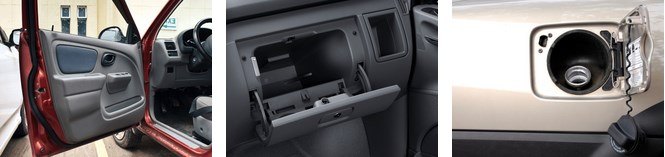
- Your driver's side door jamb
- Inside your glove box door
- Within your gas tank hatch
Here are some tips to help you manage challenging driving conditions and cut costs at the pump.
Wet Driving Tips
When it's time to head out, keep a few of these tips in mind.

1. If your windows are fogging up, use the air conditioner to dehumidify the air inside of your vehicle. If you don't have an air conditioning system, open the rear windows a crack to allow air to circulate.
2. Slowing down on wet roads is crucial. A wet road surface will offer the driver less grip compared to a dry road surface. Plus, braking distances can double and the ability to steer around an obstacle can be reduced.
3. Keep a further distance from the vehicle in front of you since braking distances can be longer on wet roads. Staying back will also take you away from the tire spray of the vehicle in front of you, giving you better visibility.
4. Vision technique is paramount to safe driving. Look further up the road and always look to where you want to be going.
5. Jerky or rushed steering can cause loss of control, especially on rain-slicked roads. Drive with smooth steering inputs.
Winter Driving Tips
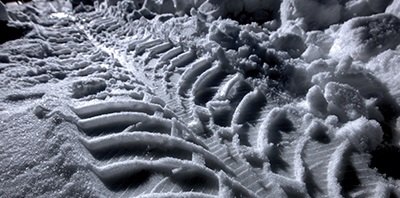
Driving in snow and ice can be a challenge. However, there are a handful of ways you can help make driving in winter conditions a safer, less stressful experience.
One important thing to remember when driving in winter conditions is to have clear visibility. Remove all of the snow and ice from your vehicle before getting inside. Work from the top down and remember to include your roof, windshield, hood, trunk, taillight and mirrors. Once you have prepared your vehicle and you're ready to hit the road, keep these tips in mind:
1. Decrease your speed. Match your driving speed to the driving conditions.
2. Always try to plan ahead and anticipate potentially dangerous driving situations, streets or areas.
3. Brake effectively. Sometimes, it's best to just take your foot off of the accelerator and let the vehicle slow down naturally. Also, brake on the straight section of the road before entering a curve, rather than braking while in the curve.
4. Be alert to other vehicles. Maintain a distance that will allow you to react to the driver in front of you.
5. If your windshield wipers are on, then your lights should be too. When driving in snow or poor visibility, utilize your lights and high beams accordingly.
6. Maintaining a comfortable cabin temperature can keep the windows free of frost, ice and snow.
7. Drive as smoothly as possible and avoid sudden braking and steering inputs.
8. Signal early when stopping or turning in order to give the vehicles behind you and oncoming vehicles extra time to react.
9. Do not drive overconfidently simply because your vehicle is equipped with anti-lock brakes, four-wheel drive, traction control or other safety devices.
10. If your car is equipped with anti-lock brakes, be familiar with their operation. A steady pressure on the brake pedal with result in a pulsing sensation. This is normal and the brakes are operating as they are designed to operate.
If you do find yourself in a dangerous black ice driving situation, remember to remain calm and apply the appropriate maneuvers. To get out of a skid, you usually don't want to hit the brakes, accelerate, or turn suddenly (if possible). Instead, you may want to try to release the brakes and turn your wheels into the direction of the slide. If you happen to steer too far and end up sliding in the other direction, try slowly turning back to the opposite direction.